
Your Leadership Team Isn’t Too Busy to Be Strategic—It’s Too Misaligned
Most leadership teams don’t have a strategy problem.
They have an alignment problem.
The CEO believes the company needs to focus on growth. Operations believes the priority is fixing internal processes. Sales wants more resources. Finance is worried about margins. HR sees burnout, turnover, and managers struggling to keep their teams engaged.
Everyone is working hard.
Everyone believes they are doing what is best for the organization.
But they may not be moving in the same direction.
And that is where growth starts to get expensive.
The Hidden Cost of Leadership Misalignment
Leadership misalignment rarely announces itself as a major organizational problem.
Instead, it shows up in smaller ways.
Decisions take too long. Meetings end without clear ownership. Priorities change depending on who is in the room. Departments protect their own interests instead of solving problems together. Leaders have the same conversations repeatedly without reaching a decision.
Eventually, employees notice.
They receive conflicting direction. They become confused about priorities. Managers hesitate to make decisions because they aren't sure what leadership really wants. Strong employees become frustrated. Accountability gets harder.
What appears to be an employee performance or culture problem may actually be a leadership alignment problem.
And adding another meeting usually isn't going to fix it.
Being in the Same Meeting Doesn't Mean You're Aligned
One of the biggest mistakes executive teams make is assuming that because everyone heard the strategy, everyone understands the strategy the same way.
Ask five executives to independently answer these questions:
What are our three most important priorities over the next 12 months?
What should we stop doing?
What could prevent us from reaching our goals?
Who owns each major initiative?
How will we know whether we're succeeding?
If you receive five very different sets of answers, your organization has an alignment gap.
That gap becomes increasingly expensive as the company grows.
When you have 15 employees, the owner may be able to personally correct confusion.
At 50 employees, that becomes harder.
At 100, 250, or 500 employees, leadership misalignment can cascade through multiple layers of the organization.
Growth doesn't solve misalignment.
Growth magnifies it.
Strategic Leadership Requires Getting Out of the Weeds
This is especially challenging for successful leaders because the people who built the organization are often very good at solving problems.
Something goes wrong, and they jump in.
A client complains, and they fix it.
An employee leaves, and they help cover the gap.
Revenue dips, and everyone focuses on sales.
An operational problem emerges, and leadership spends the week putting out fires.
Before long, the executive team has become incredibly effective at reacting—and has very little time left for leading strategically.
There is a major difference between solving today's problems and building the organization you'll need tomorrow.
Strong executive teams intentionally create space to ask bigger questions:
Where are we going?
What has changed in our business?
What are we tolerating that is holding us back?
What should our leadership team look like as we grow?
What are the three things that matter most right now?
What decisions have we been avoiding?
And perhaps most importantly:
What do we need to do differently as leaders to get the company where we want it to go?
Those conversations rarely happen between emails, client calls, employee issues, and back-to-back meetings.
They need dedicated space.
Sometimes the Conversation You're Avoiding Is the One You Need Most
Executive alignment isn't about everyone agreeing all the time.
Healthy leadership teams disagree.
They challenge assumptions. They debate priorities. They bring different perspectives to the table.
The problem occurs when disagreement becomes avoidance.
Maybe two executives disagree about the direction of the company.
Maybe roles have become unclear as the organization has grown.
Maybe one department isn't delivering and nobody wants to address it.
Maybe the company says accountability matters, but senior leaders aren't holding one another accountable.
Maybe everyone knows the organizational structure no longer works—but changing it means having uncomfortable conversations.
Those are exactly the conversations leadership teams need to have.
A productive executive workshop isn't about trust falls, motivational speeches, or filling a wall with sticky notes.
It should create an environment where leaders can address the issues that are actually preventing the business from moving forward.
Strategy Without Accountability Is Just a Conversation
There's another problem with traditional strategic planning.
Leadership teams can spend an entire day creating an impressive plan and still return to work Monday morning exactly the same.
Why?
Because strategy wasn't translated into execution.
Every major priority should answer four questions:
What are we doing?
Who owns it?
When will it happen?
How will we measure success?
If nobody owns the initiative, it isn't a priority.
If there isn't a timeline, it isn't a plan.
And if the leadership team doesn't revisit progress, today's strategic initiative can quickly become next quarter's forgotten idea.
The real measure of a successful leadership workshop isn't how energized everyone feels when they leave.
It's what changes afterward.
When Should an Executive Team Step Away?
You don't need to wait until the organization is struggling.
In fact, some of the best times to bring your leadership team together are before major transitions.
Consider creating dedicated strategic alignment time when your organization is:
Preparing for significant growth or expansion
Entering a new market or launching a new service
Experiencing leadership transitions
Restructuring roles or departments
Recovering from a difficult period
Dealing with leadership friction or organizational silos
Seeing increased employee turnover or leadership burnout
Preparing for a merger or acquisition
Facing new competitive pressure
Struggling to move strategic initiatives forward
These moments require more than operational decision-making.
They require leadership alignment.
The Goal Isn't a Better Retreat. It's a Better Leadership Team.
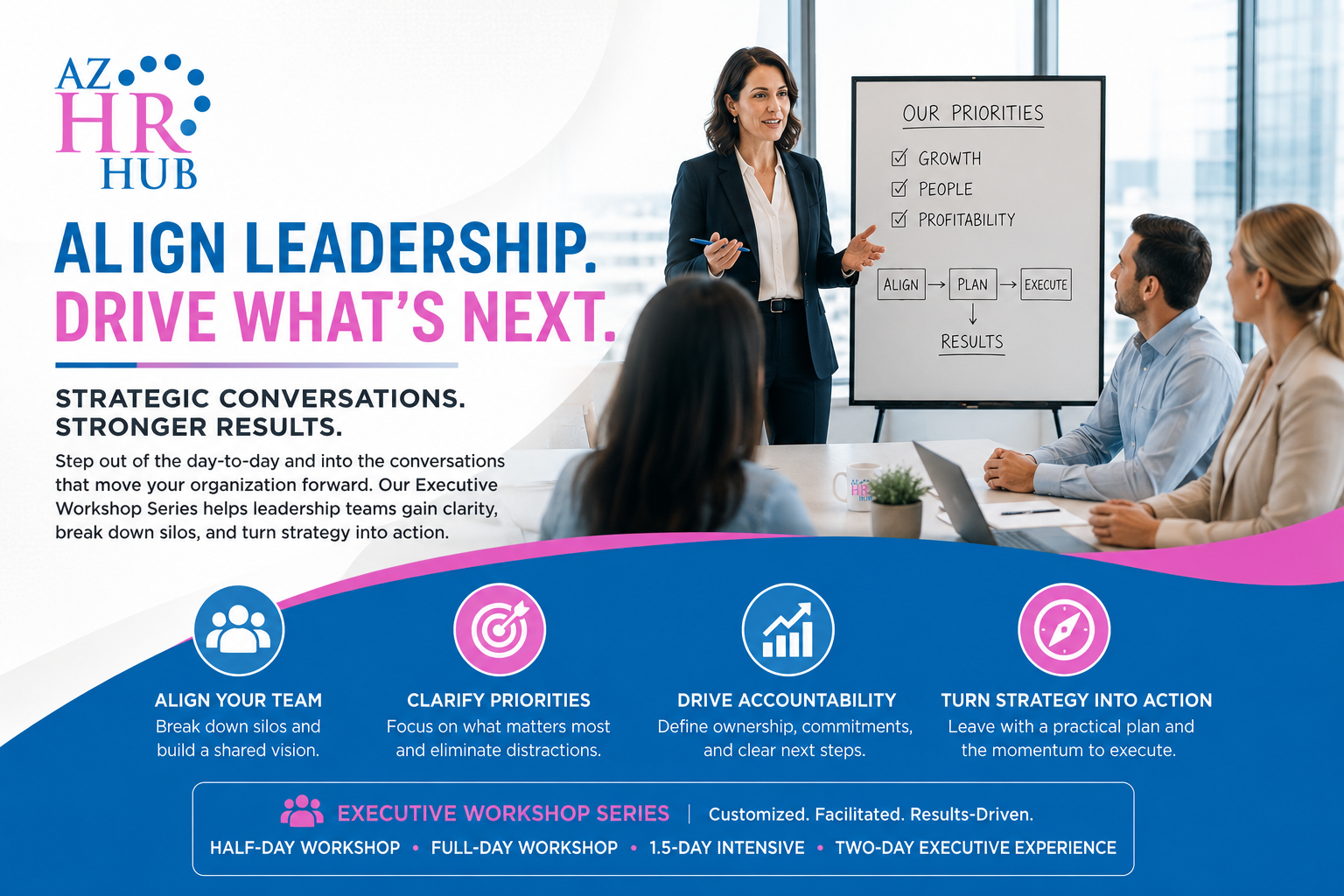
At AZ HR Hub, that's the philosophy behind our Executive Workshop Series.
We don't believe leadership teams need another generic retreat.
They need the right conversations, facilitated in the right environment, with clear decisions and accountability coming out of the room.
Depending on the organization's needs, that might mean a focused half-day session around one major challenge, a full-day strategic alignment workshop, a 1.5-day intensive that creates a 90-day execution plan, or a two-day executive reboot focused on larger organizational transformation.
Every engagement begins with discovery because the workshop shouldn't start with what the facilitator wants to discuss.
It should start with what the business actually needs to solve.
The objective is simple:
Get the right leaders in the room. Have the conversations that matter. Make the decisions that have been waiting to be made. And leave knowing exactly what happens next.
Is Your Leadership Team Truly Aligned?
Before your next executive meeting, ask everyone on your leadership team one question:
“What are the three most important things this company must accomplish over the next 12 months?”
Have everyone write their answers separately.
Then compare them.
You may discover that your team is completely aligned.
Or you may discover the conversation your organization needs to have next.
AZ HR Hub's Executive Workshop Series helps leadership teams step away from day-to-day operations, tackle the issues slowing the organization down, and turn strategic conversations into clear decisions, ownership, and execution.
From focused half-day sessions to immersive two-day executive experiences, each workshop is customized around the challenges, opportunities, and future direction of your organization.
Ready to get your leadership team out of the weeds and focused on what's next?
Learn more about the AZ HR Hub Executive Workshop Series and schedule an exploratory conversation. Feel free to reach out to linda@azhrhub.com schedule a workshop today.